Stop Ghosting Your Email List: The 3 Sequences Your Business Is Missing
Let's talk about your email list. You know, the one you were really excited about building six months ago. The one you set up a cute little opt-in for, maybe even designed a landing page, told yourself "this is the year I get serious about email marketing…”
…and then promptly never emailed anyone on it. Sound familiar? No judgment. You're in very crowded, very quiet company.
Stop looking at your email list as a chore, and instead look at it as having a gorgeous storefront with the doors locked. People showed up. They were interested. And then… you turned the lights off and went home.
In this blog, I’m going to explain to you what you need to turn those lights back on. It’s just three core sequences that a lot of service-based businesses aren’t running that are costing them clients, connections, and cash.
Why Your Email List Is Collecting Dust (And Why That's Costing You)
Email marketing consistently delivers one of the highest ROIs of any marketing channel. I’m talking an average of $10-36 back for every $1 spent, depending on the study you read.
For service-based businesses specifically, email is a goldmine because your work is built on trust and relationships. And nothing builds trust quite like showing up consistently in someone's inbox with genuinely helpful content.
But building a list and actually using it are two different things.
If you aren’t actively using your list, you won’t see those big wins. If you drop off their radar after delivering the freebie they requested, your audience will forget your name by the time you pop back up with a new offer. That silence is incredibly awkward and expensive. Every day your list sits untouched, you're leaving relationships (and revenue) on the table.
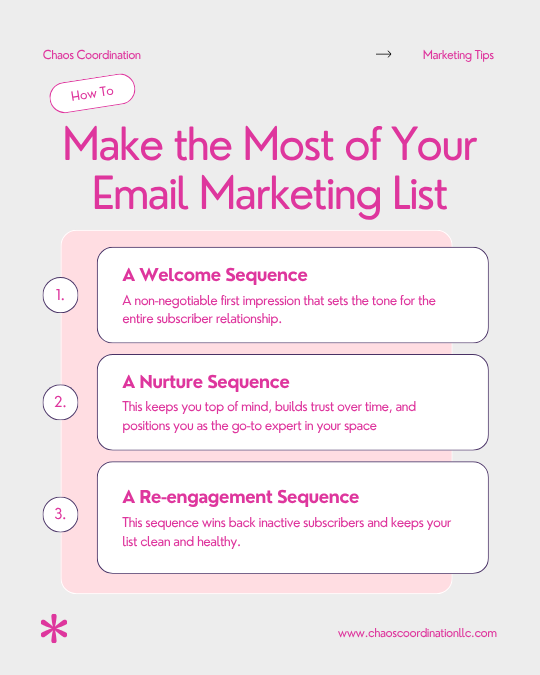
How to Make the Most of Your Email Marketing List
The Welcome Sequence: Your First Impression
Your welcome sequence is the first thing a new subscriber experiences after they join your list, and it sets the tone for everything that follows. Skip this, and you're essentially ghosting someone who just expressed interest in you. Not a great look.
What a Welcome Sequence Actually Does
A solid welcome sequence does three things: it delivers on your promise (the freebie, the discount, whatever got them to subscribe), it introduces your brand's personality, and it gently sets expectations for what's coming next.
This is also where you start building trust before you ever pitch a thing. People need to know who you are, what you're about, and why they should care, in that order.
What to Include in Your Welcome Sequence
You don't need a dozen emails here. Four is the sweet spot for most service-based businesses:
Email 1: The Warm Hello. Deliver the freebie or whatever you promised, introduce yourself briefly, and let them know what to expect from being on your list.
Email 2: Your Story. Who are you? Why do you do what you do? This is where personality shines. Don't write a corporate bio that lists all your degrees. Write a note as if you're talking to a friend at a coffee shop.
Email 3: Your Best Stuff. Share your most helpful blog post, podcast episode, or resource. Give them a reason to see you as the go-to expert in your space.
Email 4: The Soft Invite. Now that they’re familiar with you and your expertise, you can gently invite them to take the next step. Book a discovery call. Check out your services page. No pressure, just a clear path forward.
The biggest mistakes people make here? Going full sales mode in email one or delivering the freebie and then vanishing entirely. Both are trust killers.
The Nurture Campaign: Playing the Long Game Without Losing Your Mind
So your welcome sequence did its job. Your subscriber knows who you are, likes your vibe, and hasn't unsubscribed. Now what?
This is where the nurture campaign steps in. This is an ongoing, value-packed email sequence that keeps you top of mind without being that person who only shows up when they want something.
What a Nurture Campaign Looks Like
A nurture campaign isn't one sequence with a start and end date. It's your regular email content strategy.
Nurture campaigns are great for:
Educating your audience
Building your brand through storytelling
Sharing behind-the-scenes peeks
Detailing client wins
Perhaps even sharing the occasional hot take that reminds people why they followed you in the first place.
The magic formula? Mix it up. One week, share a quick tip they can implement immediately. Next week, tell a story about a lesson you learned the hard way. The week after, highlight a client transformation (with permission, obviously).
Variety keeps things fresh, and it positions you as both knowledgeable and relatable, which is exactly what service-based businesses need.
How Often Should You Send Nurture Emails?
This is the question everyone asks, and the answer is annoyingly simple: as often as you can stay consistent.
Weekly is ideal. Biweekly works if weekly feels like too much. Monthly is the bare minimum. Any less than that, and people start forgetting you again.
Here's the mindset shift that matters more than frequency: consistency beats volume every single time. Sending one genuinely helpful email every two weeks will always outperform a burst of five emails followed by two months of silence. Pick a rhythm you can actually maintain and commit to it. Your future self (and your revenue) will thank you.
And for the love of all things organized, stop telling yourself that sending emails is "bothering" people. They signed up. They asked to hear from you. Showing up in their inbox with value isn't annoying. It's literally what they opted in for. You're not being pushy. You're being of service. If they decide they no longer want to hear from you, they’ll unsubscribe.
The Re-Engagement Sequence: Winning Back the Ghosts
Let's talk about the subscribers who've gone quiet. They haven't opened an email in months. They're technically on your list, but mentally, they checked out somewhere. These are your ghosts, and they need a re-engagement sequence.
When to Send a Re-Engagement Sequence
A good rule of thumb: if someone hasn't opened or clicked on any of your emails in 60 to 90 days, it's time to reach out.
Most email platforms can segment inactive subscribers for you, so this doesn't require manual detective work. Set the parameters, identify the ghosts, and deploy the sequence.
What a Re-Engagement Sequence Looks Like
This one only needs three emails, and yes, the last one is a little dramatic. Lean into it.
Email 1: The Check-In. Something along the lines of "Hey, we noticed it's been a while. We're still here, still sharing good stuff. Here's what you've been missing." Keep it light and genuinely inviting.
Email 2: The Value Recap. Remind them why they signed up. Share a quick win, a favorite resource, or a compelling piece of content that represents your best work. Make them remember what drew them in.
Email 3: The Breakup Email. This is the "last chance" email. Let them know you're cleaning up your list, and you'd love for them to stay, but if they're not interested, no hard feelings. Include a clear "keep me subscribed" button or link.
Here's the part that scares people: some subscribers will leave. And that's actually a good thing. A smaller, engaged list will always outperform a bloated one full of people who never open your emails. Cleaning your list improves your deliverability, open rates, and data quality.
Putting It All Together: Making Email Marketing Work for You
Email marketing is just like any other type of digital marketing. It works when you work it.
Combining the welcome, nurture, and re-engagement sequences will form a full email marketing strategy that helps you make the most of the list you worked so hard to build. Remember it like this:
The welcome sequence turns strangers into warm leads.
The nurture campaign turns warm leads into trusting fans.
The re-engagement sequence makes sure no one falls through the cracks.
The beautiful part? Once these are built, they run on autopilot. Well, the welcome and re-engagement sequences do. The nurture campaign is ongoing, but it gets easier with practice.
You don't need to build all three this week. Start with the welcome sequence. It's the highest-impact, lowest-effort starting point, and it immediately improves the experience for every new subscriber who joins your list.
Most email platforms, including Flodesk, make setting up automated sequences fairly straightforward. You don't need a tech degree. You need a plan and a free afternoon – or the ability to outsource the setup.
And remember: done is better than perfect. Your first welcome sequence doesn't need to win a copywriting award. It needs to exist. You can always refine it later. The only email strategy that truly fails is the one you never start.
TL;DR: All About Email Marketing
A welcome sequence is non-negotiable. It's your first impression and sets the tone for the entire subscriber relationship.
A nurture campaign keeps you top of mind, builds trust over time, and positions you as the go-to expert in your space.
A re-engagement sequence wins back inactive subscribers and keeps your list clean and healthy.
Consistency matters more than frequency. Pick a rhythm you can actually sustain.
You don't have to build everything at once. Start with the welcome sequence and expand from there.
Ready to Stop Ghosting Your Email List?
If you've been staring at your email platform with a mix of guilt and confusion, welcome to the club, but it's time to graduate. These three sequences are the backbone of an email strategy that actually works, and you don't have to figure it all out alone.
I’m here to help you coordinate the chaos of email marketing. Check out how I can help or schedule a strategy session and let’s work through it together!