Stop Doing Everything: How to Focus Your SEO on the Pages That Actually Matter
If you've ever Googled "how to improve my SEO" and walked away more confused than when you started, you're not alone. There’s a lot of conflicting advice out there: start a blog, optimize your service pages, build landing pages, run ads, and somehow do all of it yesterday. For small business owners and entrepreneurs, that kind of advice is unhelpful and, quite frankly, can be paralyzing.
Here's the truth: not every page on your website does the same job. Building a smart SEO strategy for small businesses is more about doing the right things in the right order than trying to capitalize on every single marketing option out there.
Blog posts, service pages, and landing pages each play a very specific role in your digital ecosystem. Knowing the difference is what separates businesses that grow online from those that spin their wheels, wondering why their traffic isn't converting.
Ready to get into it?
The Real Job of Each Page Type
Before you pour time and energy into creating content, it helps to zoom out and ask: what is this page actually supposed to do?
Every page on your site has a job. When you treat them all the same, none of them does their job well. Think of your website like a business with different departments. You wouldn't ask your receptionist to close deals, and you wouldn't ask your sales team to answer phones all day. You have each team member in the role where they serve the company best. Same logic applies here.
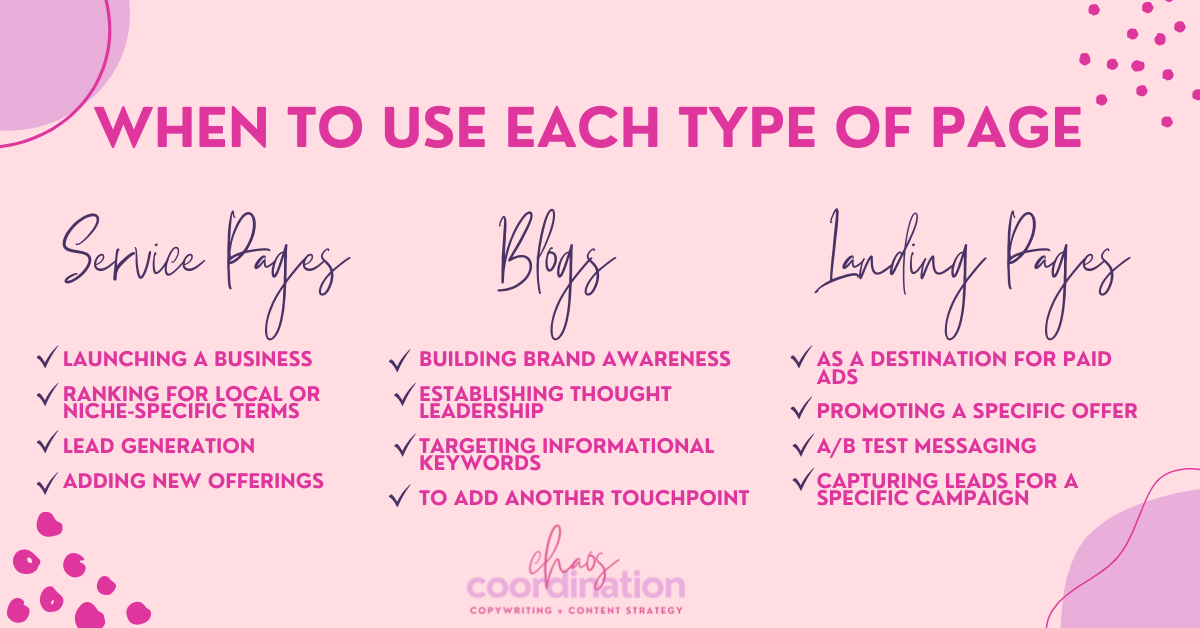
When to use each type of website page
Blog Posts: Your Long-Game Authority Builder
Blog posts are your visibility engine. They're how new people find you and how you start building credibility before someone even knows your name. A well-optimized blog targets the questions your ideal clients are already typing into Google, pulls them into your world, and starts the trust-building process.
But here's what a lot of small business owners get wrong: blog posts are not closers. They attract traffic, yes, but they rarely convert cold readers into paying clients on their own. Their job is to educate, build authority, and warm up an audience. It’s not to seal the deal.
Blogs are the right focus when:
You're building brand awareness in a competitive space
You want to establish thought leadership and authority over time
You're targeting informational search queries ("how to," "what is," "best way to")
You have a longer sales cycle and need multiple touchpoints before someone converts
The key word with blogs is patience. They're a long game that compounds over time. One great blog post can drive traffic for years, but only if it's strategically written with SEO in mind from the start.
Service Pages: The Conversion Engine You Can't Ignore
If blog posts are your top-of-funnel traffic drivers, service pages are where the magic actually happens. These are the pages that tell Google and your potential clients exactly what you do, who you do it for, and why you're the right choice. For small business SEO, service pages are non-negotiable.
A strong service page isn't just a list of what you offer. It's a strategically structured page that targets high-intent keywords (think: "brand strategy consultant for small businesses" or "SEO services in Delaware"), speaks directly to the pain points of your ideal client, and guides them toward taking action.
When someone lands on your service page, they're looking for a solution. Your job is to be that solution, clearly and confidently.
Service pages deserve your attention when:
You're launching or relaunching your business
You want to rank for local or niche-specific search terms
Your current pages aren't generating inquiries or leads
You've added new offerings that don't have dedicated pages yet
The biggest mistake small businesses make with service pages is either not having them at all, or lumping everything into one vague "Services" page. Each core offering should have its own page, optimized for its own keyword, making a specific case to a specific audience.
Landing Pages: Built to Convert, Not to Rank
Landing pages often get mistaken for service pages, but they serve a fundamentally different purpose. Where service pages are built to rank and convert, landing pages are built almost exclusively to convert.
A landing page has one goal, one message, and one call to action. That laser focus is exactly what makes them powerful in the right context.
Landing pages make sense when:
You're running a paid ad campaign and need a dedicated destination
You're promoting a specific offer, event, or freebie
You want to A/B test messaging or offers
You need to capture leads for a specific campaign
If you're a small business owner focused on growing your organic presence, landing pages probably shouldn't be your first priority. Get your service pages solid, build your blog authority, and layer in landing pages when you're ready to scale with paid traffic.
So Where Should You Actually Focus?
The honest answer is: it depends. And I KNOW … that’s an annoying answer.
But honestly, small business SEO strategy isn't one-size-fits-all, and trying to do everything at once is a fast track to burnout with mediocre results across the board.
New business? Start with your service pages. Get the foundation right. Make sure Google and your potential clients understand exactly what you do before you do anything else.
Growing business with some traction? Layer in a blog strategy. You've got the foundation, now it's time to build authority, drive traffic, and create content that supports your sales process.
Established business ready to scale? Now landing pages and paid traffic start to make sense. You've got the organic infrastructure, now you can amplify it.
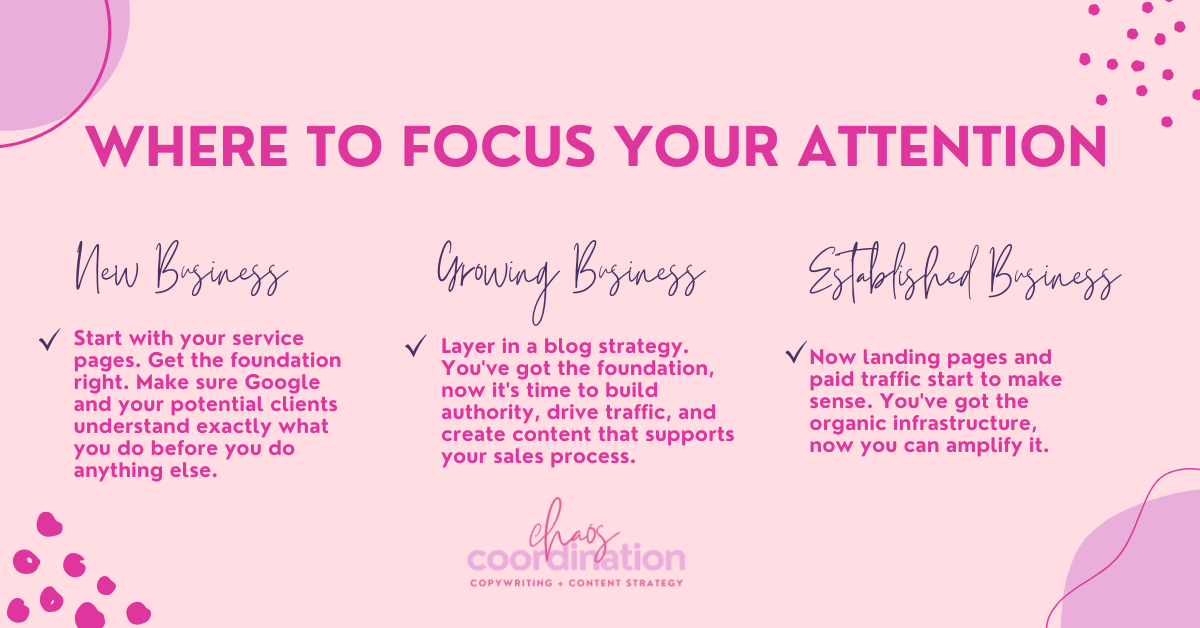
Where to focus your attention
The Smartest SEO Strategy Is a Layered One
Here's the thing nobody tells you: it's not blog vs. service pages vs. landing pages. It's blog and service pages and landing pages… sequenced strategically based on where you are and where you're going.
The businesses that win at SEO aren't the ones doing the most. They're the ones doing the right things in the right order, with intention behind every page they publish.
A layered SEO strategy means your service pages are pulling in high-intent traffic, your blog is warming up your audience and building authority, and your landing pages are ready to convert when the moment is right.
TL;DR: The Highlights
Blog posts build visibility and authority over time. They attract traffic but aren't built to convert on their own.
Service pages are the foundation of small business SEO. They target high-intent keywords and turn visitors into leads.
Landing pages are conversion tools built for campaigns, not organic search.
Where to start depends on your business stage: foundation first, then authority, then amplification.
A smart SEO strategy for small businesses is layered and sequential, not scattered and messy.
Doing the right things in the right order beats doing everything all at once, every time.
Nail Your SEO with Expert Copywriting
Ready to stop guessing and start building an SEO strategy that actually works for your business? I offer free consultation calls to help you figure out your next step.
Listen… I’ve got 3 busy kids and a growing business. I don’t have time to bullshit – which means I’ll never bullshit you. I’ll give you what you need to know and a clear path on how to move forward.
No bro marketing. No obnoxious upsells. Just open and honest communication about how you can use words to boost your business.
Sound good? I’m ready when you are. Schedule your call here.