Write Smarter, Not Harder: Budget-Friendly SEO Copywriting Tips for Small Businesses
Let's get one thing straight: you don't need a massive marketing budget to show up online, connect with your ideal customers, and actually convert them. What you do need is the right words in the right places, working hard for you around the clock.
That's the magic of SEO copywriting for small businesses. And no, it's not some mysterious dark art reserved for big brands with deep pockets. It's a skill set and a strategy that any small business owner can learn, apply, and benefit from — starting today.
So grab your coffee (or your Alani if you’re like me!) and let's break it down.
What Even Is SEO Copywriting (And Why Should You Care)?
SEO stands for Search Engine Optimization. Copywriting is the craft of writing words that persuade people to take action. Put them together, and you've got content that does two powerful things at once: gets found on Google AND convinces real humans to buy, book, or reach out.
Most small business owners are either writing stiff, robotic, keyword-stuffed content for Google or writing warm, engaging, but impossible to find content for other humans.
The sweet spot? Both. That's where copywriting for small businesses becomes a genuine growth strategy rather than just a task on your to-do list.
When done well, great SEO copy keeps working for you long after you hit publish. Blog posts, web pages, and optimized service descriptions can drive organic traffic for months or even years. That's a seriously high return on a one-time investment.
Start With What You Already Have: The Copywriting Audit
Before you write a single new word, take a good honest look at what you've already got. This is called a copywriting audit, and it's the most underrated starting point for small business owners.
A copywriting audit means going through your existing website copy, social media bios, email sequences, and any other written content and asking:
Is it clear? Can someone land on my homepage and know exactly what I do and who I serve within 5 seconds?
Is it keyword-informed? Am I using the words and phrases my ideal customers are actually Googling?
Does it have a call to action? Am I telling people what to do next or just hoping they figure it out?
Does it sound like me? Or does it sound like a corporate robot wrote it?
You'd be amazed at how many small business websites have beautiful design but copy that's doing absolutely nothing. A quick audit can reveal low-hanging fruit. Most of the tweaks you need to make will take just a few minutes, but can meaningfully improve your traffic and conversions.
Not sure where to start? That's exactly what a professional copywriting audit is designed to help with. (More on that in a sec. 👇)
Copywriting Tips for Small Businesses on a Budget
Ready for the practical stuff? Here are the strategies that actually move the needle without requiring you to spend a fortune. Because, in this economy, who has it?!
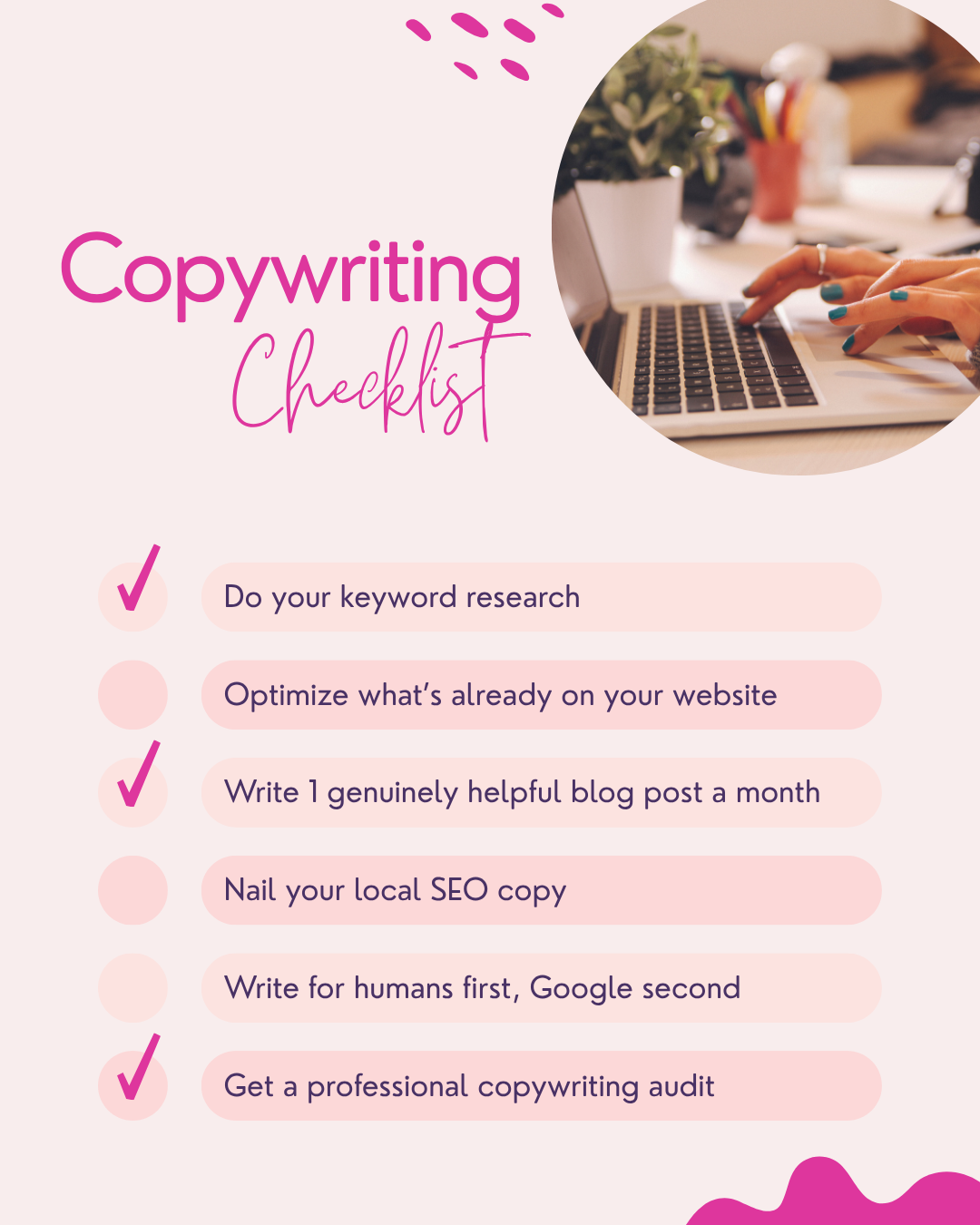
Copywriting Checklist
1. Do Your Keyword Research
Keywords are the phrases your potential customers type into Google when they're looking for what you offer. The good news? There are free tools to help you find them.
Start with Google's autocomplete feature. Just start typing a phrase related to your business and see what Google suggests. Those suggestions are real searches from real people. Don’t forget to check the "People Also Ask" section on any search results page. These are gold mines of content ideas and natural keyword phrases.
Tools like KeySearch, Google Search Console, and Answer the Public can give you even more data and ideas on words to use.
If you’ve known me for any amount of time, you know that this is the part of the blog where I’m going to scream DO NOT KEYWORD STUFF YOUR CONTENT! Keyword stuffing is lame. Readers hate it. Google hates it. I hate it (if that matters to you). Instead, focus on naturally incorporating the words your audience is already using.
2. Optimize What's Already on Your Website
Here's the best-kept secret of copywriting on a budget: you don't always need to create new content. Sometimes you just need to refresh what's already there.
Go back to that copywriting audit mindset and look at your:
Page titles and meta descriptions: Are they descriptive and keyword-informed?
Headlines (H1s and H2s): Do they include your target keywords naturally?
Service pages: Do they clearly describe the benefit to the customer, not just the feature?
Homepage: Does it pass the 5-second clarity test?
Small tweaks to these elements can have a noticeable impact on your search rankings over time. This is exactly the kind of copywriting for small business owners that pays dividends without requiring a huge content production machine.
3. Write One Genuinely Helpful Blog Post Per Month
You don't need to blog every day. You don't even need to blog every week. One well-written, SEO-informed blog post per month is enough to start building authority in your niche, especially for local businesses.
The key is to write about things your customers are actually searching for. Think:
"How to [solve a problem your business solves]"
"[Your service] in [your city] — what to expect"
"X things to consider before hiring a [your type of business]"
These posts position you as the expert, bring in organic traffic, and give you content to repurpose across your social platforms. That's a triple win for copywriting services for small businesses on a tight timeline.
4. Nail Your Local SEO Copy
If you serve a specific geographic area, local SEO is your best friend. Make sure your website copy naturally includes your city, region, or service area, not in a spammy gross way, but in a way that makes sense contextually.
Nothing makes me cringe harder than when I see copy that looks like this: the best dance school in town, town, town, town, town, town, town, town, town. We teach jazz dance in town, town, town, town, town. Learn ballet from us in town, town, town, town, town. Like girl. Be so for real. Knock it off and just be normal.
Your Google Business Profile is also a piece of copy real estate. Optimize your business description, keep your services up to date, and respond to reviews thoughtfully. All of this signals to Google (and to potential customers) that you're the real deal in your area.
5. Write for Humans First, Google Second
Google's algorithm is increasingly good at recognizing genuinely helpful, human-first content. Keyword stuffing doesn't work anymore (plus, I hate it.). Robotic, hollow copy doesn't convert (plus, I hate it.)
The best copywriting for small businesses reads naturally, speaks directly to the reader's pain points, and moves them toward a clear next step. When your copy does that well, the SEO performance tends to follow.
Use contractions. Write like you talk. Address your reader directly. And for the love of all things good, have a call to action on every page. Every. Single. Page.
6. Invest in a Professional Copywriting Audit
Look, there's a lot you can do yourself when it comes to copywriting on a budget. And I am no gatekeeper, so I fully support you doing it.
But there are also moments when bringing in a professional is the smarter financial move, because bad copy costs you money in missed conversions and lost search visibility.
Signs it might be time to get support:
Your website has been up for a while, but isn't generating leads
You've updated your copy, but still aren't ranking for anything
You know your business inside and out, but struggle to articulate it clearly online
You've never had a professional copywriting audit done
Sometimes, a fresh set of eyes (specifically if those eyes belong to someone who specializes in copywriting services for small businesses) can spot the issues immediately and get you back on track faster than any amount of solo tinkering.
The Bottom Line
Great copy levels the playing field. You may not have the budget of a Fortune 500 company, but you have something they often lack: authenticity, a clear niche, and a real relationship with your community. With the right copywriting for small business owners strategies in place, those advantages show up in your search rankings and your bottom line.
You don't have to figure it all out alone (heyyyy!) and you definitely don't have to spend a fortune to get started.
Ready to Take the Next Step?
Like I said, I’m no gatekeeper, so here’s a free SEO Checklist you can use to start optimizing your website right now.
Or if you're ready for a professional set of eyes on your content, schedule a copy audit and let's find out exactly what's working, what's not, and what to fix first. Because you are too damn good and your copy should be working as hard as you are. 💪