The Small Business Owner's Guide to Local SEO Copywriting
If you've ever Googled something like "best coffee shop near me" or "plumber in [your city]," you already understand the power of local SEO. You just might not have known what to call it.
For small business owners, especially those with a brick-and-mortar storefront, showing up in those hyper-local search results could be the difference between a steady stream of local customers and watching them walk straight into your competitor's door.
The good news? You don't need a massive marketing budget or a computer science degree to make it happen. What you do need is the right words in the right places — and that's exactly what local SEO copywriting is all about.
Whether you're a boutique owner in Delaware, a landscaper in Charlotte, or a bookkeeper in Denver, this guide will walk you through how to write content that gets you found by the people who are already looking for exactly what you offer.
What Is Local SEO Copywriting (and Why Should You Care)?
Local SEO copywriting is the practice of writing website content, blog posts, and other digital copy specifically designed to help your business rank in location-based search results. Think of it as the intersection of great storytelling and strategic keyword placement with a very specific goal: getting your business in front of people in your geographic area.
Here's where it differs from general SEO:
Traditional SEO is broad. It's about ranking for topics and terms that could apply to anyone, anywhere.
Local SEO is intentionally narrow. It's about making sure that when someone in your city searches for a query related to your services, your business shows up.
Writing for local SEO means your content speaks directly to a local audience, uses location-specific language, and signals to Google that you are the go-to resource in your area.
For small business owners, this is one of the most powerful tools in your toolkit. You may not be able to out-spend a national brand, but you can absolutely out-local them. And that's where writing for local SEO gives you a serious edge.
Understanding Your Local Audience Before You Write a Single Word
Before you even think about keywords or blog topics, you need to get crystal clear on who you're writing for. The more specifically you can speak to your ideal local customer, the more effectively your content for local SEO will perform.
Your local audience has a context that a broader audience doesn't. They know the neighborhoods. They reference local landmarks. They have community-specific concerns and preferences. When your content reflects that, it builds an instant sense of trust and familiarity — which is exactly what converts a casual reader into a paying customer.
Questions to Ask Before Writing Content for Local SEO
Use these questions to guide your content strategy before you write a single word:
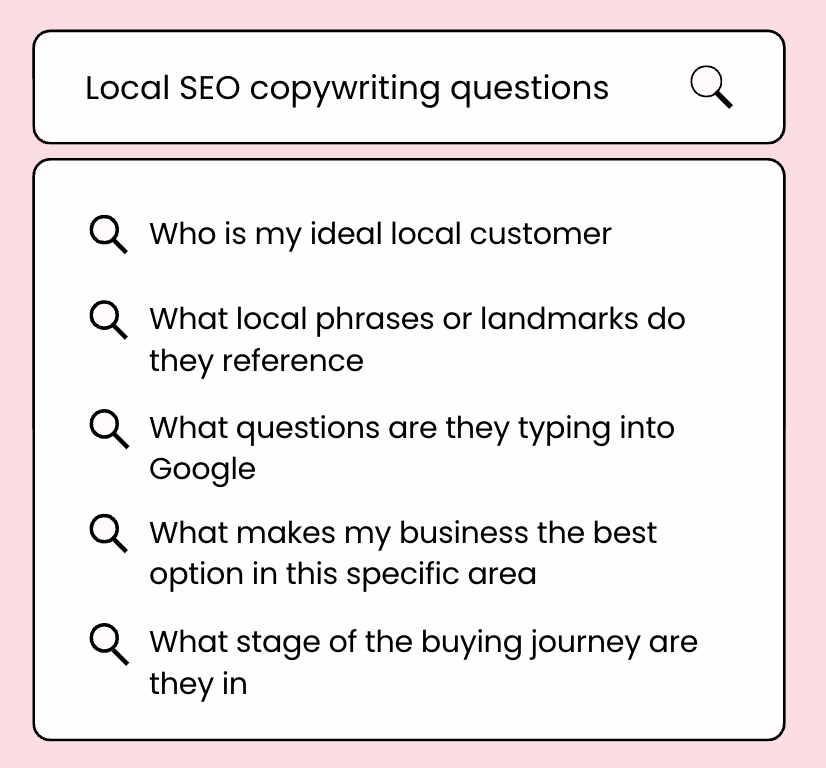
Local SEO questions to ask
Who is my ideal local customer? Think age, lifestyle, profession, and what problems they're trying to solve.
What local phrases or landmarks do they reference? Do they say "the loop" or "downtown"? Do they reference specific neighborhoods?
What questions are they typing into Google? Tools like Google's "People Also Ask" feature are goldmines for this.
What makes my business the best option in this specific area? Your local differentiators should show up in your copy.
What stage of the buying journey are they in? Are they just browsing, or are they ready to book/buy right now?
Answering these questions will help you create content that feels personal, relevant, and genuinely useful to the people you're trying to reach.
How to Weave Local Keywords Into Your Copy Naturally
Now let's talk keywords, the backbone of any solid local SEO strategy. Local keywords typically follow a simple formula: service + location. Think "emergency electrician in Phoenix" or "wedding photographer near Baltimore." These are the phrases your potential customers are actually typing into search engines, and your job is to make sure your content speaks their language.
Finding your local keywords doesn't have to be complicated. Start with Google itself. Type in your service and see what auto-populates. Check the "related searches" at the bottom of the results page.
You can also use free tools like Google Keyword Planner or Ubersuggest to get a sense of search volume in your area. The goal is to find phrases that are relevant, specific, and realistic for your business to rank for.
Where to Place Local Keywords in Your Content
Once you've got your keywords, placement matters just as much as the keywords themselves. Here's where to work them in:
Page title (H1): Your main keyword should appear in the title of every key page on your site.
Meta description: This is the short blurb that appears under your link in search results. Make it count.
First 100 words of your content: Google pays attention to what appears early in your copy.
H2 and H3 subheadings: Naturally weave location-based terms into your section headers where it makes sense.
Body copy: Aim for a natural, conversational mention every few paragraphs. Not every sentence!
Image alt text: Describe your images using location-specific language where appropriate.
URL slug: When possible, include your location in the URL (e.g., /plumber-austin-tx).
One word of caution: keyword stuffing is very real, and it will hurt you. And also I hate it so much.
If your copy reads like a robot wrote it, Google will notice. And so will your readers. Always write for humans first, search engines second.
Writing for Local SEO: Content Types That Actually Work
Not all content is created equal when it comes to local SEO. Some formats are particularly effective at boosting your local visibility, and knowing which ones to prioritize will save you a ton of time and guesswork.
Each of the following content types serves a different purpose in your local SEO strategy, and ideally, you'd use a combination of all three to build a well-rounded online presence.
Location Pages
If you serve multiple cities or neighborhoods, dedicated location pages are non-negotiable. Each page should be written specifically for that area. Do not just copy and paste the same content with a different city name swapped in. That’s annoying af, but also Google will notice and you’ll start to get hit with duplicate content penalties. Include local references, mention specific services you offer in that area, and make it feel like it was written for that community.
Blog Posts
Blogging is one of the most underutilized tools in local SEO for small businesses. A well-written blog post targeting a local keyword can drive consistent organic traffic for months or even years. Consider topics like:
Top 5 Reasons [City] Homeowners Choose Metal Roofing
What to Look for When Hiring a Family Lawyer in [City]
A Local's Guide to [Service] in [Neighborhood]
The Insider’s Scoop on Daycare Centers in [City]
These posts position you as a local expert and give Google more content to index. Win-win!
Google Business Profile
Your Google Business Profile (formerly Google My Business) is one of the most powerful pieces of local SEO real estate you have access to — and it's free.
The description section of your profile is a prime opportunity to naturally incorporate your local keywords. Keep it conversational, highlight what makes you unique, and make sure your business name, address, and phone number are accurate and consistent with what appears on your website.
Always keep this page updated. Add new pictures. Create posts. And always answers your reviews!
Local SEO Copywriting Mistakes to Avoid
Even with the best intentions, small business owners often fall into some common traps when it comes to content for local SEO. Here's what to watch out for:
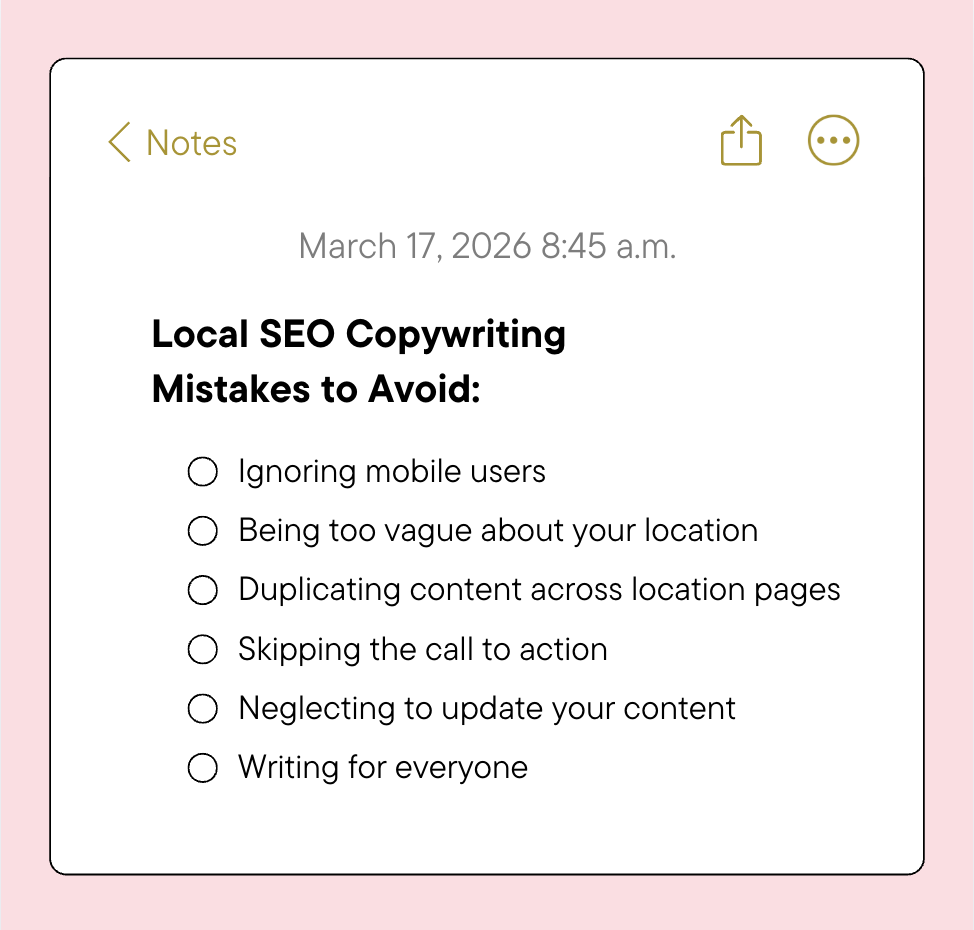
Local SEO mistakes to avoid
Ignoring mobile users: Most local searches happen on mobile devices. If your content isn't easy to read on a phone, you’ve already lost.
Being too vague about your location: Don't just say "serving the greater area." Name your city, your neighborhoods, your service zones. Tell the people where you are!
Duplicating content across location pages: Google penalizes duplicate content. Each page needs to be genuinely unique.
Skipping the call to action: Great local SEO copy informs, but it also needs to convert. Every page should have a clear next step for the reader.
Neglecting to update your content: Outdated information signals to both Google and your readers that you're not actively engaged in your business. Regular updates keep your content fresh and relevant.
Writing for everyone: The biggest mistake of all. If you're trying to speak to everyone, you're speaking to no one. Get specific, get local, and get personal.
Key Takeaways: What You Need to Know about Local SEO
You've made it through the crash course. Here's a quick recap of what to carry with you:
Local SEO copywriting is the strategic use of location-specific language and keywords to help your business rank in local search results.
Know your audience before you write. Understanding your local customer's mindset will shape every word you write.
Local keywords follow a service + location formula and should be placed naturally throughout your content. Think: titles, headers, body copy, and metadata.
Location pages, blog posts, and your Google Business Profile are the three most effective content types for building local SEO authority.
Avoid common mistakes like duplicate content, vague location references, and forgetting to include a call to action.
Consistency and specificity are your best friends. The more intentional and location-specific your copy is, the more you will be rewarded.
Ready to Put This Into Action?
Knowing the strategy is one thing. Actually implementing it is another, and that's where a lot of small business owners get stuck. If local SEO still feels like a lot to wrap your head around, don't worry. That's exactly why this free resource exists.
Grab my Ultimate SEO Checklist — a jargon-free, 20-step guide packed with actionable strategies you can start using right now to boost your local visibility. No tech background required. No massive budget needed. Just clear, practical steps that actually move the needle.
Your future customers are already out there searching. Let's make sure they find you.